My #overlyhonestmethods story

Single crystals suitable for X-ray crystallographic analysis were obtained when a solution of the salt in EtOAc/nC6H14/MeCN was allowed to stand at 20 °C for about 1 d.

That sentence appears in the X-ray characterization section of only the second paper I published — an Angewandte from 1998.

First of all, I’m embarrassed that the information that is given is not even close to being adequate to repeat the crystallization (if it’s any excuse at all — and it’s not a good one — this paper was submitted within 6 months of me beginning my PhD and was the first paper I had some involvement in writing; my first paper was from a project I did as an undergrad and the paper was written without me). What concentration of the compound was used, and what was the ratio of those three solvents. But secondly, HOW ON EARTH DID I COME UP WITH THAT WEIRD COMBINATION OF SOLVENTS?!

Well, sit back, put your feet up, and get ready for the #overlyhonestmethods version of the story.

I’d been trying to crystallize this particular compound for months — it was something I had made as part of my final-year undergraduate project; a project I was continuing with for my PhD. You don’t really need to know what the structure of the compound was, other than the fact it was a salt, with a large-ish organic cation (the interesting bit) and pretty much any anion you may choose to associate with it. Most compounds of this type in the research group were prepared using a non-coordinating anion such as hexafluorophosphate (‘non-coordinating’ means that the anion doesn’t form a tight ion pair with the cation, and the cation is free to start forming interesting complexes without the anion getting in the way).

The hexafluorophosphate salt was not particularly soluble in most organic solvents. It would go into acetonitrile (up to a point) and it was also soluble in DMSO, but that was pretty much it. So, it could be characterized by NMR spectroscopy, but I had no luck growing crystals from acetonitrile (and it didn’t even cross my mind to try DMSO). Every crystallization attempt would just produce an amorphous white powder — nothing that was going to give me a nice crystal structure. After many months of frustration, I think a postdoc in the group badgered me into running a 13C NMR to try to get a better picture of what was happening in solution (the molecule was a self-complexing one; the idea was that it would form intermolecular complexes that would resemble interwoven chains, and since the 1H NMR spectrum was very complicated, he suggested 13C might be more revealing).

I wanted to make a concentrated sample to get a good spectrum, and I knew that I couldn’t do that in acetonitrile. DMSO would be able to dissolve a large amount of the compound, but the compound didn’t form complexes in DMSO (no matter how concentrated), so that was no good. Instead of using hexafluorophosphate as the anion, I thought I’d give trifluoroacetate a go — I’m not sure why, but perhaps others in the group had been using this anion too. So I made the trifluoroacetate salt and was pleasantly surprised to find out that it was quite soluble in chloroform. Brilliant. I’d run the 13C NMR in CDCl3, the solvent I ran most NMR experiments in.

At that time, the NMR spectrometers in the department ran as a service — you weren’t allowed to touch them yourself. The only time you could run a 13C spectrum was overnight, and they had to be queued up on the carousel before the NMR facility was locked and closed for the night at 6 pm (I just heard a collective gasp from all of the US grad students/postdocs reading this — but yes, the NMR suite was locked shut at 6 pm; no way of getting in). So, you couldn’t run your own NMR spectra and if you wanted a 13C spectrum you had to make sure you got one of the 20 overnight slots.

So there I was in the lab (on the 7th floor of the building) and I glanced at the clock to see that it was about 5:50 pm. I quickly grabbed my bottle of CDCl3 from the shelf on my lab bench and added about 1 mL of it to a sample vial containing about 100 mg of my trifluoroacetate salt. It looked like the stuff wasn’t completely dissolving and because I was in a rush, I just decided to grab my bottle of CD3CN and add a few drops of that. Hey presto, everything dissolved. I dutifully filtered the solution into the NMR tube through a small amount of glass wool stuffed into a pipette, capped the tube, and raced to the lift to head down to the ground floor to get into the NMR suite before it closed.

I just made it. I got my sample on to the carousel and I think they locked the door behind me as I left and returned back to the lab. I went back to my lab bench to clean up and it was then that the horror hit me. Our bottles of CDCl3 were very distinct; they were dark brown glass, big blue screw caps and weren’t cyclindrical, but had a square cross-section. Once I’d finished with one, I’d often re-purpose them to hold TLC solvent mixtures. It turned out that the bottle of ‘deuterated chloroform’ on my bench that I had just used wasn’t actually a bottle of CDCl3 — in my haste, I had grabbed the wrong one off the shelf; one that was clearly labelled, in my own handwriting, as containing a 1:1 mixture of hexane:ethyl acetate. So, my NMR sample had been made up using (non-deuterated) hexane/ethyl acetate and a few drops of deuterated CD3CN. Bugger.

Had this been any other time of the day, I would have trudged back downstairs, retrieved my NMR tube, evaporated off the solvent, and re-made the sample using CDCl3 (and not informed anyone of my utter stupidity). As it was, the NMR lab was locked, there was no way in, and I resigned myself to picking up a nice 13C NMR spectrum of hexane/ethyl acetate the following morning (as well as looking like an idiot). The morning came, I picked up my spectrum (which was as useless as you would expect it to be). I think all of the samples had already been cleared off the carousel and were in a rack waiting for collection. I don’t remember for sure, but the guy who ran the NMR machines might have even written something less that complimentary on my spectrum (yes kids, these were the days of paper spectra; no electronic versions available for students…).

I don’t know when I noticed, but at some point between the NMR suite on the ground floor and the lab on the seventh floor, I looked at the NMR tube and saw what I can only describe as BLOODY HUGE CRYSTALS in there. The boss was away, but the senior postdocs booked me on a train the very next day to carry my precious cargo to Imperial College in London, where our crystal structures were all solved. The rest is history, and the crystal structure got me an Angewandte paper — and ended up being the basis for one of the chapters in my thesis.

So, that’s my #overlyhonestmethods story for you.

As a postscript, I should point out that the deuterated solvent, the strong magnetic field of the NMR machine, the spinning at 20 Hz for 30 minutes and the periodic shunting around an NMR-machine carousel were NOT required for the crystallization. In repeat experiments, a mixture of ethyl acetate and regular acetonitrile produced crystals in a vial sitting quite still on the bench top in the absence of a strong magnet…
Posted in In the lab | Tagged , , , , , , | 2 Comments

The life editorial (in brief)

With apologies to @BenchFly (who sent me a set of thought-provoking career-related questions a long time ago now — and I promise I will answer them at some point), here is a short post to take part in the #ChemCoach carnival being organized by @SeeArrOh.

My current job

I am the Chief Editor of the journal Nature Chemistry.

What I do in a standard work day

In some ways it’s a fairly predictable job — just get one issue of the journal out each month and publish papers online every Sunday as soon as they are ready. Having said that, there is no ‘standard’ work day. As the Chief Editor, a lot of what I do is the same as the Associate/Senior Editors, but there is an additional layer of shit responsibility that comes with the role.

The day-to-day journal business revolves around the manuscripts that are submitted to the journal. Editors spend a lot of time reading manuscripts, reading ‘the literature’, finding referees, chasing referees, making decisions based on referee reports — and explaining them to the authors (and the referees). For the manuscripts that ultimately make it into the journal, editors will have provided a lot of feedback to the authors concerning the text and figures, and the editors also do the ‘final read’ after the authors have returned their proof corrections.

Editors also commission content for the journal such as review articles, book reviews, News & Views articles, Commentaries, and miscellaneous pieces for other journal sections (and all of this involves being up-to-date with the literature as well) — and when that content comes in, we edit it too. Writing is also a core (but small) part of the job. Editors write 300-word research highlight articles and occasionally editorials and press releases too. And in the small amount of time left over, editors sometimes blog (not very often, admittedly) and tweet. And some days involve not being in the office — we give talks at universities and we also go to conferences.

As the Chief Editor, I’m also responsible for the development of the journal, including long-term strategy and planning. Also, if any problems arise — such as accusations of plagiarism or other nefarious publishing acts, they make their way to my desk. I’m also involved in cross-company projects that look at how we present our content online and how we can make it better. And anything that involves our editorial workflow and how we interact with print production and web production is my domain too.

Oh, and e-mail. We get lots of e-mail. Chief Editors in particular. I probably spend 1-2 hours each day writing and answering e-mail.

What kind of schooling / training / experience helped you get me there?

I went through a fairly traditional career path to begin with: undergraduate degree, PhD, postdoc. I then took a teaching-faculty position, but at the same time I started work in the newly founded Organic Letters editorial office at UCLA. The Associate Editor was Fraser Stoddart (my former PhD supervisor). I think Fraser looked at the first half-a-dozen papers that were submitted and each time he asked me what I would do. After that, I just did them without bothering him.

Over the next 2.5 years, I think Fraser got involved on a handful of occasions, typically when there was the odd messy appeal. That was my first experience working in journals — and it was kinda fun. There was no formal training for the job — but I think it helped that during my PhD and postdoc I’d written 50 or so papers and read a lot of literature. After that, I made the leap back across the Atlantic to Nature Nanotechnology as an Associate (and then Senior) Editor. Just over two years later, I started the ball rolling on Nature Chemistry.

How does chemistry inform my work?

Although we don’t really assess manuscripts in a technical sense — that’s the job of the referees — it is very helpful in reading and evaluating a manuscript if we have some level of understanding when it comes to the actual science. You have an idea of whether what is being claimed is significant and whether any claimed implications of the work are outlandish or not. The vast majority of Nature journal editors have a PhD (and many have postdoc experience too). And academic background and expertise are usually major factors in making a job offer to potential candidates. Unlike some publishers, we look for particular types of chemistry expertise and then we make use of that on the job. Someone with a physical chemistry background will evaluate physical chemistry manuscripts, an organic chemist will look at organic chemistry manuscripts and so on…

A working knowledge of chemistry also comes in handy when going to conferences and visiting labs. If you can talk with a researcher about their chemistry without sounding like an idiot, then it obviously helps — and can sometimes encourage submissions. Nobody likes having their manuscript rejected, but if it’s done by someone who seems to know what they’re talking about when it comes to the science, that can reassure the author that the editor at least understands the work they are evaluating. (Of course, that doesn’t apply to everyone — some don’t deal well with rejection, no matter the background of the editor).

We also need to know about chemistry when we write for the journal — we need to identify interesting topics to cover in research highlights and we need to be able to express technical ideas quite simply for a general chemistry audience. Take stereochemistry, for example, which is one of my favourite topics. It is one of the hardest things to write about clearly for a general audience — especially if you don’t have pictures to help illustrate your words, which is sometimes the case.

A unique, interesting, or funny anecdote about my career

When we were setting up Nature Chemistry, we needed a banner graphic for the top of our website. You can still see it now — it’s the purple periodic-table fragment at the top of pages like this one. There I was, planning to just do this myself, but one thing you soon learn about going from academia to the real world, is that many things ARE NOT YOUR JOB. We have graphic designers to do this sort of stuff. So, I asked our designer to make a nice slanted periodic table with funky lighting effects. I even provided a sketch. What I got was a lovely and quite stunning periodic table. But it was based on some sort of stock image that had made-up elements in it (and even the real ones were in the wrong order!). I then had to explain why that might be a problem… it took 3 or 4 more iterations before we got to the banner image that is there now… Sometimes the subtleties of chemistry are very easily lost on non-chemists.

Posted in Careers, Carnivals, Publishing | Tagged , , , , , , , , , | Leave a comment

My Olympics

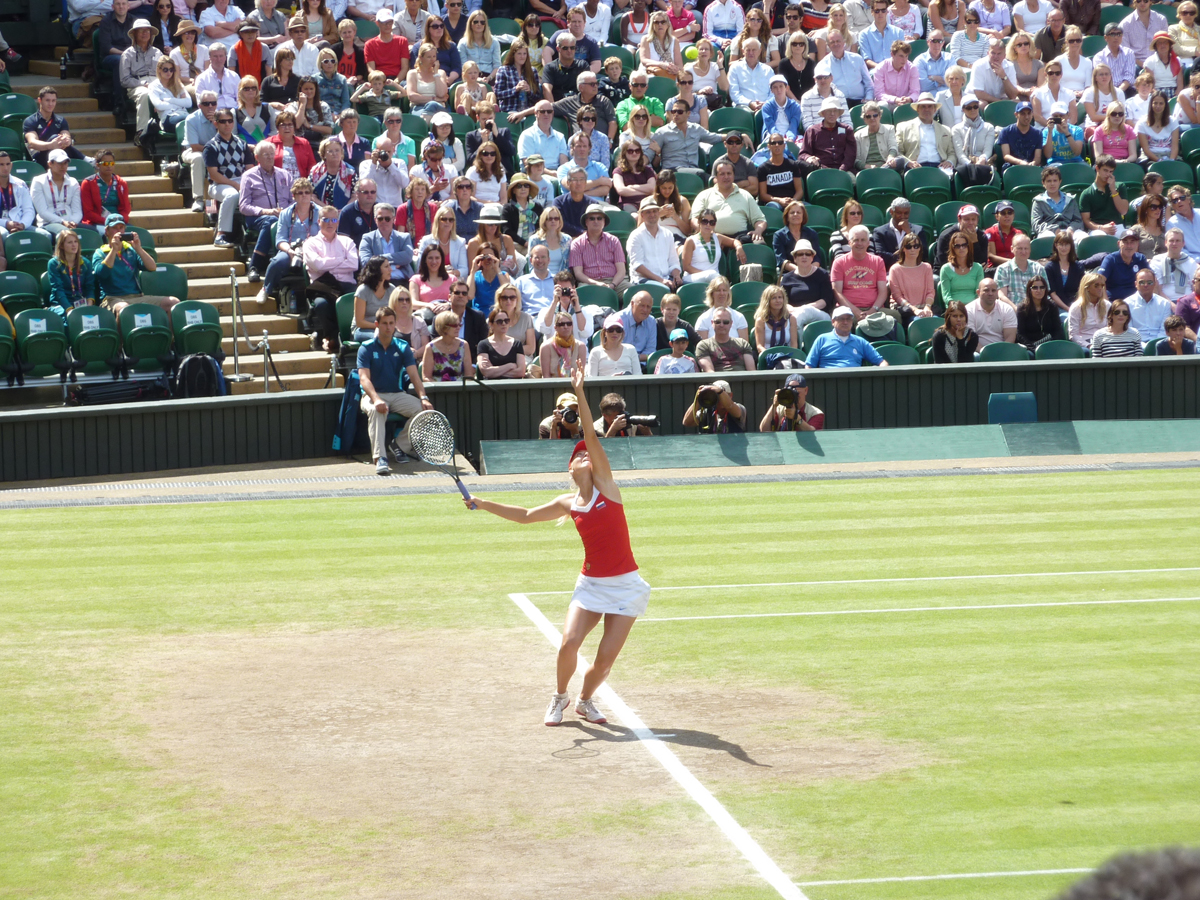
We were lucky enough to see a couple of events at the London 2012 Olympics… first up was some tennis at Wimbledon. We got to see Murray and Robson in the mixed doubles (beating the Australians — which is always a bonus — in the quarter-finals). The main event, which turned out to be a major non-event, was the women’s singles final between Williams (Serena) and Sharapova. It finished 6-0, 6-1. The most dramatic moment happened during the medal ceremony, when the US flag fluttered gently to the ground when it came loose during the anthem. Anyway, here’s a photo that you can play spot-the-ball with…

After that, we saw the final of the men’s doubles, followed by the semi-final of the women’s doubles (with the Williams sisters triumphant once again). Then, on the last day of the Olympics, we headed off to the Olympic park to see some batshit-crazy people flinging themselves around an indoor court trying to injure one another handball.

When we were applying for Olympic tickets, handball wasn’t at the top of the list, in fact, it wasn’t on my list. But as my last chance to see an event in the Olympic park, when a friend asked if we wanted last-minute tickets to the bronze-medal match in the men’s handball (between Hungary and Croatia), I said yes. Before the game, the fairly lame efforts of the chap wearing the jean shorts/jacket/shirt/tie combo to get the crowd excited didn’t do much, but the music did the trick. A theme that continued in the game.

I’m not going to try and describe the rules of handball, in fact, I’m still not convinced there are all that many, even though they ran through them before the game began. If you want to know more, the Wikipedia page is here, but it does little justice to what actually happens in one of these games — the article does include the phrase ‘player sandwich’, but unfortunately it’s nowhere near as exciting as it sounds… Anyway, one of the best bits about the matches at the Olympics was the music (I don’t know if this is normal).

When a player is awarded a 7-meter throw (think penalty — or, for my US readers, penalty kick), ‘Under Pressure’ is pumped out of the auditorium’s speakers — brilliant. When a player gets a 2-minute suspension, you hear ‘Sit Down’ by James. When a player gets wiped out and doesn’t get up after hitting the floor, they even have music for this — Clocks, by Coldplay… “…the lights go out…”. When they finally get up (assuming they are not carried off on a stretcher), we hear Tubthumping, by Chumbawumba… “…I get knocked down, but I get up again…”. If only the Premier League did this!

Anyway, here’s one of the less blurry photos of the action… this breakaway resulted in a goal.

And to finish off, here are a couple of photos from around the park. Here is The Orbit, it’s quite photogenic.

And a much better photo than the ones I took of The Orbit and the stadium — taken by my lovely wife on an earlier trip to the park to see a game of handball during the heats (she’s a bit of a handball nut to be fair…).

So, it’s all over now. There wasn’t any travel chaos during my commute to work. TeamGB were amazing. The opening ceremony was utterly awesome, and I’ve not seen the closing ceremony yet, but it’s waiting for me, a quiet evening, and a nice glass of red. I kinda miss the Olympics.

Posted in Fun | Tagged , , , , , , | Leave a comment

Where I’ve been (in the name of SCIENCE!)

I’m not quite sure who started the whole #sciencenomads thing on Twitter (I think either @Chemjobber or @SeeArrOh), but it got me thinking about all the places I’ve visited/worked because of SCIENCE! Sure, if I’d never got into chemistry (or science), I might still have travelled a lot, but I’m quite surprised at how far science has taken me. I’m sure I’ve missed some, but below are places I’ve worked, conferences and departments I’ve visited, and other places I’ve been to in some kind of professional (rather than personal) capacity. Not bad considering I was either 18 or 19 (can’t remember which) before I first got on an aeroplane – and that was also the first time I set foot outside Britain. (At some point I might get around to annotating the map, but at the moment it’s just a list of places…).

 
And apologies for not blogging for a very looooooooong time… normal service not quite ready to resume, but this is a start!

Posted in Careers, Fun | Tagged , , , , , , , , | 1 Comment

I’m still here

Well, at least I got into double figures in terms of number of posts before I had to write this one, in which I assure you that I’m still here and still intent on blogging.

I’ve been somewhat sidetracked recently — and a large part of that is because I’m recruiting for a new associate editor at work. Deadline has passed, applications are in, and now the hard work starts. We’ll hopefully have made an offer to someone by the end of May, following manuscript tests and interviews.

The last post on peer review keeps gnawing away in the back of my mind, reminding me that I need to do a wrap-up post. I will, at some point… but for now, go and have a look at the numbers (and if you haven’t voted yet, why not give it a shot).

I’ve also been drawn into the Breslow #spacedino saga, that has been covered in a number of places around the web. The latest is a blog post from Nature News in which I am quoted. As I’ve said now on Twitter too, if this is not a case of self-plagiarism, then I don’t know what is.

I’m also working on some answers to really insightful interview questions from Alan at BenchFly (I am doing them Alan, I promise). And I’ve also been working with Erin from The Story Collider to slightly adapt my #IAmScience post about my Dad for them. That should be appearing soon.

And with all that said, I’m off to the Bürgenstock conference in Brunnen next week… an amazing conference and my third visit.

Posted in Housekeeping | Tagged , , , , , , , , , , | 2 Comments

Peer-review polls

I’m starting to think about some of the talks I’ll be giving whilst on my travels later in the year. Questions relating to peer review inevitably crop up — about double-blind peer review, open peer review, or why the vast majority of journals don’t publish referee reports, and so on… Without boring you senseless with a long list of questions, below are three that sprang to mind earlier today. I realise this is hardly a controlled experiment and the sample size might not be huge — but I’m interested to see how the vote goes. I’ll leave the polls open for a little while and do a wrap-up post when I get the chance. If you have anything interesting to say about peer review — or any questions — then please comment!

A couple of notes:

1. These questions aren’t related to any impending change of policy at my day job — or indeed to how I do my day job. I’m just genuinely curious to see how the votes go.
2. If I never have to insert another poll into a WordPress post, it will be too soon. Talk about infuriating.


Posted in Publishing | Tagged , , , , , | 16 Comments

My ChemDraw hell

Here’s a challenge for you. Draw the structure below in ChemDraw – so that it looks as pretty as it does here* – and let me know how long it took you. If you can do it in under 3 hours, you’re a better ChemDrawerer** than I am. Of course, you probably have much better (and more interesting) things to do with your time.

*it looks better if you click through to the full size image
**yes, I’m sure that’s a real word

Posted in Fun | Tagged , , , | 24 Comments

My science story (and my Dad)

There is not a lot of chemistry in this post (and not too many laughs either) so consider yourself warned if that’s what you usually come here for.

After seeing some of the #IAmScience tweets and reading this blog post that started it all, I thought it was about time to share my science story. If any of my friends or colleagues are reading this and wondering why they’ve never heard this story before, it’s because it isn’t the sort of thing you casually drop into a conversation. Why am I telling all and sundry here on the blog? You know what, it’s easier that way — and it feels good to tell the story.

This is the story of why I became a scientist, not what I’ve done since becoming one. I can’t recall a particular moment in time when I said to myself, “I want to be a scientist”. Even though I made conscious decisions to study particular subjects at school and then at university, there was never really a plan or a lofty goal — I just picked subjects I enjoyed (or thought I would enjoy). I didn’t always get it right: the first time I went to university it was to study for a physics degree — I dropped out after a week.

It was my Dad who triggered my interest in science. It wasn’t really anything he said, or anything he did, but rather who he was. From quite a young age (I don’t remember when exactly), I knew that he was sick. He suffered from haemophilia — a genetic disorder that prevents your blood from clotting properly. In the most common variant of the condition (haemophilia A), the body does not produce enough of something called Factor VIII — a glycoprotein essential for blood clotting to occur. In some individuals it’s not the quantity of Factor VIII that’s the problem, but the quality: a faulty version of the protein is produced and it doesn’t do what it should.

What did this mean on a day-to-day basis for my Dad? Well, if he cut himself, he would bleed for a very long time — this would be hours rather than minutes. Being fully aware of his condition, he was obviously very careful not to cut himself. The one thing you have no control over as a haemophiliac, however, are the spontaneous internal bleeds. He would often have a lot of joint pain — because he would be bleeding internally into his joints — and not be able to bend his arms or legs very well. The pain was severe and some days he could barely walk. Even on the best days, he walked like an old man.

Because of his condition, my Dad didn’t go to school; he had some home tuition, but not a great deal (we’re talking 1940s/1950s coal-mining English town here). A lack of formal training combined with the physical manifestation of his haemophilia meant that he never had a regular job. Nevertheless he was naturally quite intelligent — he taught himself from scratch how to repair clocks and watches. He would fix them for relatives, friends, and friends of friends, and it would be done for the price of the parts plus a few pounds more — if you went to a jewellery shop it would cost at least 10 times as much. Unless it was a Timex — apparently they were a nightmare to fix and he told people it would be easier for them to get a new watch.

I was fascinated with the bits and pieces that came out of a watch. How could all of those little parts even fit inside the case, let alone work together in harmony to plot out the passage of time in regular beats? I wanted to know how things worked — as many small boys do — and this was my own (very personal) introduction to taking things apart and putting them back together.

But something else that really interested me was my Dad’s condition. It was my introduction to rudimentary genetics: X and Y chromosomes and recessive traits. The history of haemophilia itself also fascinated me. We lived a simple life in a council house, but haemophilia was ‘the royal disease‘. Royal! Through her children, Queen Victoria spread the disorder through many of the royal houses of Europe. Perhaps the most famous were the Romanovs who, after turning to Rasputin to heal their haemophiliac son, met their bloody fate in a basement at the hands of the Bolsheviks.

Anyway, back to my Dad. One way of relieving the joint pain when it got too severe, or to stop a bleed that just kept going, was to make the trip to hospital where he would be given an infusion of Factor VIII. This also intrigued me. My Dad had this disease, but some clever people had figured out what the problem was and how it could be managed (there is no cure for haemophilia). This was a revelation to me. ‘Magic’ is the wrong word, but it was certainly amazing. If it wasn’t for the fact that I am embarrassingly squeamish, I might have gone into medicine. Seriously, much to my wife’s amusement, I can’t even watch the surgery bits on ER/Grey’s Anatomy/Casualty. If it wasn’t going to be medicine, science seemed like a good alternative — but even so, it wasn’t a carefully thought out plan for what I wanted to be when I grew up, it just seemed like something I might enjoy doing.

So, Factor VIII was the answer, and it certainly improved my Dad’s quality of life. For a while. It turns out that the early 1980s weren’t a great time to be a haemophiliac in need of Factor VIII treatment. For those of you who don’t know how the story ends, the name Ryan White might ring a bell. If it doesn’t, well, here goes. At that time, many of the blood products used to treat haemophiliacs were contaminated with HIV and many patients were infected — my Dad included. It was a death sentence. I was 15 when my Dad died of AIDS. He was 48.

This didn’t trigger some kind of heroic life-long quest, either to seek a cure or to avenge the sense of cosmic injustice that I felt. And it didn’t, in any conscious fashion that I can identify (even now), cement any pact I had with myself to be a scientist. But it did leave me wanting to know more about these short and scary acronyms that had turned my world upside down. Maybe the 15-year-old me thought that there might be some comfort in better understanding what had happened to my Dad. More than 20 years later, I can tell you that there isn’t any.

So I continued on the path of science. I worked hard, did well at school, and then went off to university to do a degree in chemistry & bioorganic chemistry (after that brief and spectacularly unsuccessful flirtation with physics). I’ve been fortunate to work with some amazing people in some great places, and I’ve travelled the globe — but all of that is a different story for a different day. And even though I’m now an editor, I still consider myself to be a scientist. It’s not a job, it’s a state of mind.

So, there wasn’t a Eureka moment. It was a gradual embrace that had its roots in my childhood and, in particular, my Dad’s illness. I may well have found my way to science even if things had been different — and how I wish they had been different. But things are what they are, and that being the case, there’s only one thing left to say. Thank you Dad.

Posted in Life stories | Tagged , , , , , , , , , | 11 Comments

The value of PR stunts?

I’ve been a member of the Royal Society of Chemistry (RSC) for many years now; I think I’m coming up on my 15th year. The RSC does a lot of good things — and I know many people who work there and enjoy catching up with them at conferences. But there is one thing in particular that the RSC does that makes me roll my eyes (and many of the chemists I know have a similar reaction). Occasionally the RSC puts out a light-hearted press release that has only a very tenuous link to chemistry, or no discernible link to chemistry whatsoever.

Yesterday’s effort (which foreshadowed an event today) was titled: Mrs Beeton’s all-bread sandwich recreated for tough-times Britain. The release tells us that, “The RSC decided to promote Mrs Beeton’s toast sandwich because it might just be what we need to get us through the harsh economic times that are forecast.” Well isn’t that nice of them? Nothing much to do with chemistry though.

As noted in an article in 2010 by Brian Emsley on the Association of British Science Writers website, “The generating of historically-based or eccentric stunts has been part of the RSC mainstream PR now for eight years and each year we think that we have exhausted the seam but then another concept springs up happily.” The basic idea seems to be that if you can generate media interest through these stunts and raise the profile of the RSC, then when important issues in chemical policy, research or education crop up, the press are more likely to remember the RSC and go to them for comment. And through a fairly extensive exchange I had on Twitter today, it seems that once the RSC has got their foot in the door with the national media with one of these stunts, they can use the opportunity to raise other chemistry-related issues.

But does it work? I’m not convinced. Of course, I could be wrong. But I can’t help but imagine that the vast majority of people reading the stories or listening to the interviews go away and remember the gimmick, but not much more. Maybe I wouldn’t object so much if there was some fundamental chemistry underpinning these stunts that was more of an integral part of the press release — and that people went away with just a tiny bit more understanding about science or chemistry. But then again, I guess the stories might not be picked up so much if that was the case. Trying to increase the engagement of chemists and chemistry with the public is something I think is very important, I’m just not sure this is the right way to go about it.

There has also been some criticism on Twitter that there are more important things going on in chemistry that should be more of a priority for the RSC — most notably the current funding policies of the Engineering and Physical Sciences Research Council (this blog will give you one side of the story). I also think there are other great ‘public interest’ stories that powerfully demonstrate the importance of chemistry — one that caught the eye today is Dave Smith’s very personal story about the chemistry that makes organ transplantation possible. Find 15 minutes and go and watch it.

I think my comments on the latest RSC PR stunt touched a few nerves, with @RSC_Comms branding me a ‘hypocrite’ for daring to criticize the toast-sandwich offensive after I have previously written about the chemistry of cookies here on this blog. As I pointed out, I’m not a professional society that charges members dues to fund my activities. My blog is a personal one with a chemistry slant that I post to in my spare time. There’s a difference!

Anyway, I’m probably being somewhat precious about this, but what do you think? Are the RSC PR stunts helping raise the profile of chemistry in the UK? Lemme know!

*My lovely — and sensible — wife made me change the title of this post from what I originally planned. One day I’ll let you all know what it was.

Posted in Fun, Publishing | Tagged , , , , , , , , , , , , , , | 13 Comments

Cookie chemistry

Apologies for the lack of posting here. I’ve always been impressed with the output on a lot of the chemistry blogs that I peruse, but since starting this blog I now have an even deeper sense of wonder and awe at how some people manage to put out interesting blog posts day after day.

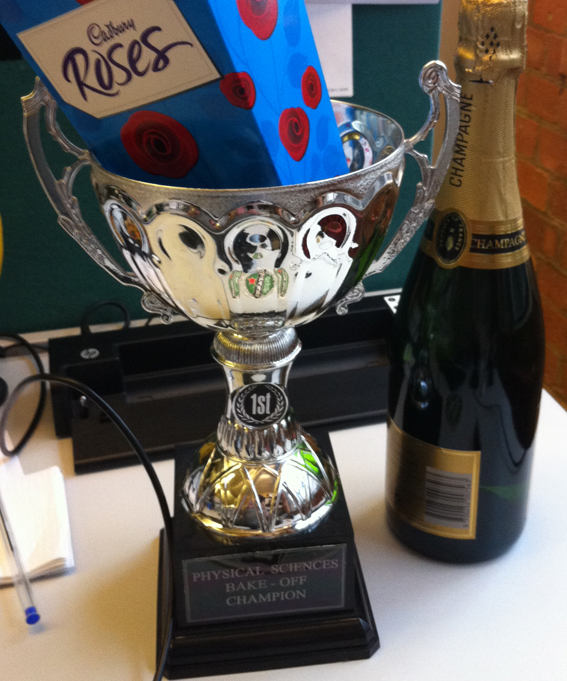
Now, let me tell you about the Nature Physical Sciences Bake-Off — mostly because I won the second running of this competition(!), but also because it involves some (kitchen) chemistry.

The physical sciences department at NPG includes the publishing, editorial and production staff associated with the physical science journals, namely Nature X, where X = Materials, Physics, Nanotechnology, Chemistry, Geoscience, Climate Change and Photonics. Not everyone on these teams is based in London, but many of us are.

The first bake-off was last year, and it focused on cakes. Each week, two people from the physical sciences department (drawn at random) would go head-to-head by baking a cake and bringing it into the office on a Friday. At 3 pm, an e-mail would go around announcing that the cakes had been cut and everyone should go and try some of each. This is a great way to finish off a Friday afternoon.

After everyone retired to their desks, we would be asked to vote, by e-mail, for the best cake. And to ensure maximum fairness in the peer-review process, we would not know who had baked which cake. Once the votes were counted, the winner was announced and they would progress to the next round to do battle once more, and so on. More than 30 people took part and so there were quite a few rounds before the final. I was knocked out in round 2 (thanks Gav) and so was spared more baking duty.

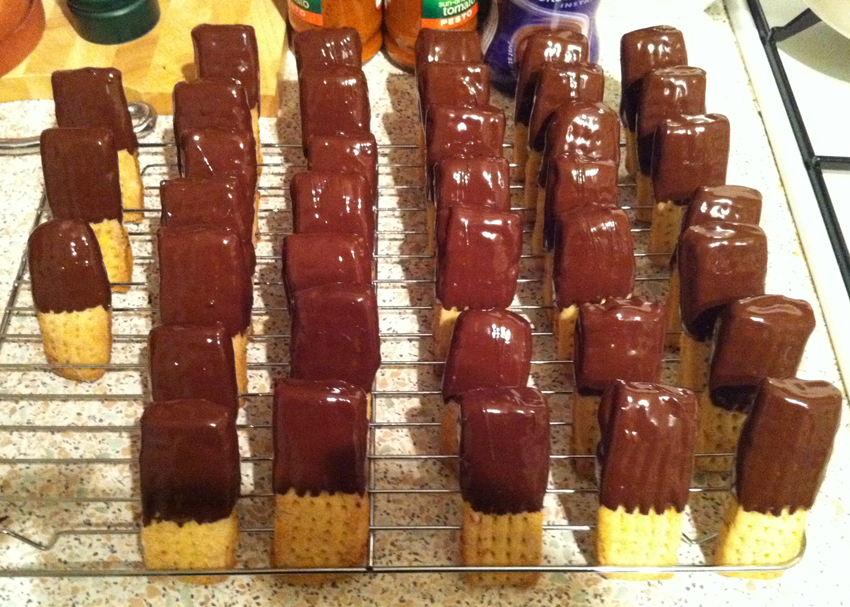
This year, the bake-off tackled biscuits (or cookies for any American readers out there). I made some almond butter biscuits (straight from a recipe book) for round 1, narrowly beating the Chief Editor of Nature Physics and went through to round 2. Here I improvised a little and made some chocolate-dipped orange shortbread (see pic), which seemed to go down well and so I progressed to round 3. Here, we started baking in threes to make the competition go a little quicker, and these ginger biscuits won the day. (Note: I had to use much more flour than listed in the recipe, after adding what was listed, I still had a soupy mixture — rather than a dough — that certainly couldn’t be rolled into balls).

Round 4 was the semi-final and I think we were back to baking in pairs. After liking how the ginger biscuits worked out in the previous round, I thought I’d do a variation on that theme and found this recipe for chocolate-chip ginger nuts. No need to play around with this recipe, it worked a treat and the biscuits were well received once more and I made it through to the final. My opponent for the final, Cecilia, was the current holder of the bake-off trophy (yes, there is a trophy) after winning the cake competition the year before.

So, what was I going to make for the final? I figured that it needed to be something special. Well, we had recently featured ($) in the Blogroll section of Nature Chemistry a blog post by Deborah Blum at Speakeasy Science about chocolate chip cookies. After she’d put so much effort into perfecting her recipe, I thought I would give it a go! I modified it slightly by adding some orange essence (why don’t you get orange chocolate chip cookies?!), and for any non-US readers, below is the recipe from Deborah’s blog translated into UK measurements/ingredients.

Reagents:

225 g butter
260 g light brown sugar
2 medium eggs
2 tsp vanilla essence
3 tsp orange essence* (my addition, not in original recipe)
340 g self-raising flour
1 tsp bicarbonate of soda
1 tsp salt
300 g of milk chocolate chunks

Procedure:

Cream the butter and sugar, then add in the eggs one-by-one and beat after each addition. Add in the vanilla and orange essence and stir into the mixture. Sieve in the flour/salt/bicarbonate of soda mixture and mix well before stirring in the chocolate chunks. Leave the mixture to chill for 30 minutes (I did this outside the back door but the fridge should be fine). Deposit heaped teaspoons of the dough on to a baking sheet leaving plenty of space for the cookies to spread. There’s so much butter in the recipe, I certainly didn’t need to grease the baking sheet. And I had to cook them for longer than specified in Deborah’s recipe; my best results came from baking them for exactly 12 minutes at 180 deg C in a fan oven. Leave them to cool on wire racks and then devour.

And so the day of the final dawned — and my slightly orangey choc chunk cookies won the day! So, thanks to Deborah for a great recipe and thanks to chemistry for being so delicious!

Posted in Fun | Tagged , , , , , , , , , , , , , | 5 Comments