Make-or-break chemistry

When I told Rachel that I would write something for the favourite chemical reactions #chemcarnival being organized by C&EN, I started thinking about the reactions I did during my career at the bench (undergrad, PhD, and postdoc).

My least favourite reaction sprang to mind pretty quickly — but that’s a whole different blog post for the future. Let’s just say that I was working in a lab over the summer between my 2nd and 3rd years as an undergraduate, and the reaction involved a LOT of sodium cyanide and one of those coffee-bean grinders with the really sharp blades. Let your minds run free…

Having spent two years in the Mecca of metathesis at Caltech, it would have been too easy to choose that particular Nobel Prize-winning reaction as my favourite. The pull of ruthenium is strong — even though I joined Bob’s group to work on Mo-based chain-transfer agents, it wasn’t long before I was playing with the purple powder. The fact that the first Mo compound I made in Pasadena decomposed under vacuum (yes, I said vacuum — all I was doing was trying to dry it!), probably didn’t help.

So, my favourite reaction? Making and breaking imines. Synthetic chemistry is not just about making bonds, it’s about breaking them too you know.

Let’s start with the easy bit. Making an imine is a pretty simple process. Take an aldehyde and a primary amine and mix them together. You can add an acid catalyst if you want (not too strong mind, you don’t want to protonate your amine out of the equation). The amine attacks the carbonyl of the aldehyde and you generate a hemiaminal. These things don’t stick around for long because they eliminate water to give the imine (but if you’re really clever you can take a sneaky picture of one of them at low temperature in a well-defined solid).

The reaction exists as an equilibrium — the water can attack the imine and the sequence is reversed to give the aldehyde and the amine that you started with. What use is that you might ask? More on that later. Anyway, because we have an equilibrium, we can call on our friend Le Chatelier to help us out. If we can find a way to remove water from the system, the reaction will be driven to the right and we can make the imine in really high yields.

One particularly elegant way to remove the water is to use one of my favourite pieces of chemistry glassware, a Dean-Stark trap. You put one of these between your reaction flask and the condenser and you heat your aldehyde and amine in a solvent such as toluene that can form an azeotrope (one of my favourite chemistry words – see it’s all good!) with water. As the solvent condenses, it drops into the Dean-Stark trap and the water separates from the toluene and falls to the bottom of the trap because of its higher density — the only thing that gets recycled back into the reaction flask is toluene (assuming your trap is big enough to cope with the volume of water formed during the reaction). It’s just so neat and tidy.

Of course, not every imine you make will be particularly happy in boiling toluene, so there are other methods of removing the water, such as adding drying agents including magnesium sulfate or molecular sieves.

So, making imines is fairly straightforward. But why would we want to break them apart again? Well, imine formation (and cleavage) is an example of dynamic covalent chemistry, which can be really quite useful if you want to make just one particular product in a reaction that could potentially yield a vast number of different compounds. The idea is that if the reactants combine to form the incorrect product, that compound can be recycled back into the equilibrating reaction mixture and the system keeps evolving until it reaches an energy minimum. As such, the outcome of the reaction is under thermodynamic control (the final products are decided by their relative energies and the covalent bond-forming reactions are reversible) rather than kinetic control (the final products are decided by which reactions happen the quickest and the covalent bond-forming reactions are irreversible).

For example, if you react together a compound containing two aldehydes with one containing two amines, you could make lots of imine polymers of different lengths — as well as cyclic compounds where the ends of the polymer chains react intramolecularly. If imine formation was irreversible, you’d likely end up with a mess, but the reaction is reversible, so there exists the potential to bias the reaction to give a single product — the one that is energetically most stable. And that’s how you can make funky molecular topologies, such as the Borromean rings shown below (see this post for more background).

Dynamic covalent chemistry can also be applied in combinatorial systems — so-called dynamic combinatorial chemistry, pioneered by the likes of Jeremy Sanders and Jean-Marie Lehn (amongst others). Such approaches can be used to create synthetic hosts to bind small molecules, or conversely, to find small molecules that can bind to larger structures, such as inhibitors for enzymes as one example (subscription required).

Imines are just one example of a functional group that lends itself to this sort of dynamic chemistry. Others include esters, disulfides, hydrazones and even olefins (metathesis is a reversible reaction under the appropriate conditions). But imines are the ones I’ve played with myself, and so they’re my favourite.

Posted in Carnivals, In the lab | Tagged , , , , , , , , , , , | 1 Comment

Drawing conclusions

How do you draw your benzene rings?

No, not how do they look when you’re finished, but what are the motions you go through when you put pen to paper? And I do mean pen to paper, obviously drawing benzene rings with your favourite chemistry-drawing software is done with a simple click of a button.

I started thinking about this when I saw this comment on one of @Chemjobber‘s posts — one in which Carmen Drahl gets a shout out for including hand-drawn chemical structures in some of her posts over at CENtral Science. This, in turn, led to a call by Carmen for readers to send in pictures of structures drawn by their own fair hands — the gallery can be found here.

So, benzene. When you first put pen to a blank piece of paper, you have a number of choices to make. Do you draw the hexagon so that its top and bottom are parallel to the top of the piece of paper, or so that the left and right sides are parallel to the left-hand side of the piece of paper? Or put more simply, is your hexagon sitting on a single point, or is it resting comfortably on one of its sides? Of course, if the benzene ring is part of a larger structure, you might be forced to choose one orientation over another. But if you’re just drawing a single solitary benzene ring, or if you’re not constrained in any way by the bigger picture, do you always start by drawing your benzene ring the same way up?

Orientation aside, once you’ve made that decision, which way do you move the pen? Do you always follow the same sequence of strokes? Do you lift the pen from the paper before completing the hexagon and going on to the double bonds? After giving it some thought, I’m pretty sure I always draw my benzene rings the same way — and if you’d asked me to describe how I did it without actually going through the motion, I’m not sure I would have got the answer right. I guess it’s because it’s second nature; I’ve done it so many times it just happens, and the way I do it is tucked away in my subconscious somewhere. So, for me, I always sit my benzene rings on a point (if I have a choice) and I lift my pen off the paper twice before even completing the hexagon. And I’m pretty sure I always draw the double bonds in the same order and direction as well. Full gory details shown in the picture.

Just as Chemjobber suggests that a chemist’s hand-drawn structures are a signature of sorts and Carmen agrees that they carry an echo of personality — I think the way in which we actually draw the structures probably varies quite a bit from person to person as well (what it says about an individual, however, heaven only knows!). There are hundreds of ways you could actually draw the nine different lines that make up a benzene ring (probably only a handful of sensible ones though) — but just imagine the permutations for something like Taxol! And yes, benzene has nine lines, anyone out there drawing a hexagon with a circle in the middle just needs to stop.

I realise this is all a bit silly, but it did get me thinking about drawing structures. So, how do you draw yours?!

Posted in Fun | Tagged , , , , , , | 19 Comments

The smallest chiral hydrocarbon?

Last week I posed the following question:

What is the lowest molecular weight hydrocarbon that is chiral? (A couple of restrictions — isotopes don’t count, so no deuterium or 13C, and no conformational stereoisomers, I’m looking for stable enantiomers at room temperature).

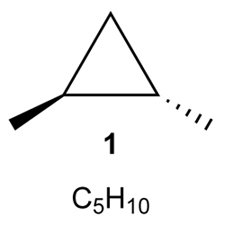
This all came about because of a question I used on an exam I wrote a few years ago for an undergraduate organic chemistry class. My intention was to ask the same question on the blog but, of course, I accidentally missed out a few details — which ended up making the question a bit more interesting. The original question asked the students to identify the lowest molecular mass cyclic alkane (the previous question on the exam had asked about the corresponding acyclic alkane). I don’t really remember how well the class did on the question, but the structure I gave on the exam’s answer key was trans-1,2-dimethylcyclopropane (1). It turns out that this might not — technically speaking — have been the best answer… sorry kids.

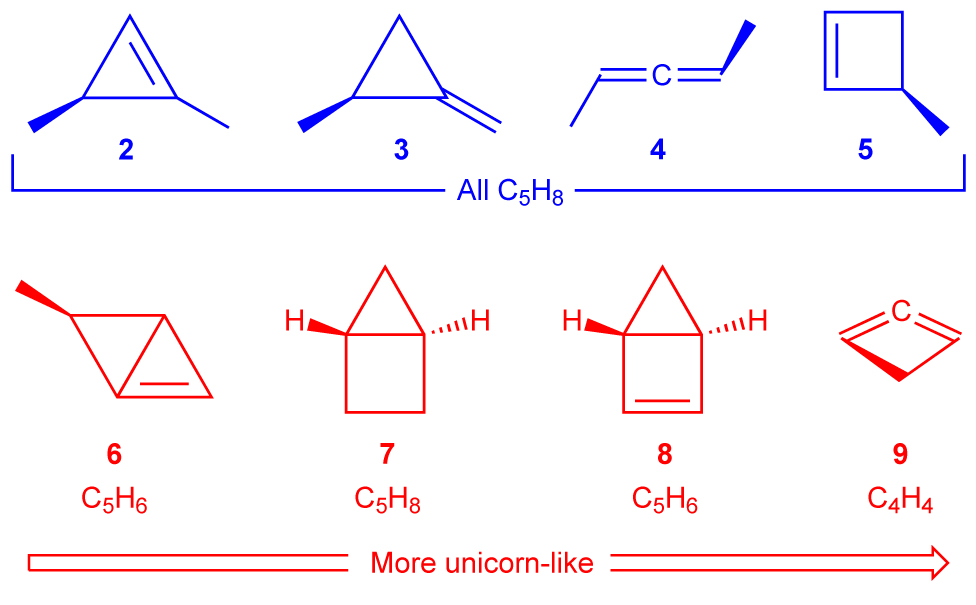
Well, if you don’t specify ‘alkane’ and you use the word ‘hydrocarbon’ instead, that means unsaturated systems are fair game — and this means that there are better answers than 1. There seem to be four fairly reasonable isomers of C5H8 that fit the bill — compounds 25 below. I was quite happy with this set of answers until a few clever people on Twitter suggested some others. @MatToddChem came up with the bicyclobutane structure (6), although this does violate Bredt’s rule. Then @zhorakovsky followed up with the bicyclopentane (7) and bicyclopentene (8) compounds — but these structures are probably far too strained to exist with those trans-fused ring junctions. Finally, @stephengdavey pointed out that 1,2-cyclobutadiene (9) would also be a valid answer, if it existed.

So, while all of these answers are OK on paper, the blue ones are much more likely to exist than the red ones. Nevertheless, from what seems to be a very simple question, you can start thinking about structure, bonding, isomerism, stereochemistry, and strain. And if it floats your boat*, nomenclature too (*it doesn’t mine, and this might be the topic of a future post). And that bit above where I mentioned not giving the correct answer on the original exam? Well, that bicyclopentane structure (7) is definitely an alkane and has a lower molecular mass than the trans-dimethylcyclopropane (1)… in my defence, however, 7 probably doesn’t exist.

Thanks to everyone else who suggested answers on Twitter or in the comments of the original post!

Posted in Fun, Quiz time! | Tagged , , , , , , , , | 16 Comments

Pop quiz #1

In my former life I taught organic chemistry — sometimes to classes of 300. A significant fraction of the students were ‘pre-med’ which for those of you who don’t know, roughly translates as, ‘I couldn’t give a crap about chemistry, but I need an A in this class so that I can go to a decent medical school’. I realise that’s a horrible stereotype… some pre-meds did actually find chemistry fascinating and really wanted to learn and understand things. In my experience, however, the majority didn’t.

I was teaching in the US system having myself been educated in the UK. I came from a land where (at least when I was going through the system) the average score on an exam was not typically in the 70-80% range, unlike in some of the courses my US students had taken — including chemistry ones. If you scored that well in the UK over the course of your degree, you generally received the top classification.

So, I took great pleasure in setting exams that would give a class average of roughly 50%. I also wrote questions that tested understanding rather than memorization. This, in the short term, made me somewhat unpopular. It only ever resulted in the one death threat*, however. (*Note – I’m not making this up). After time passed and wounds healed, and my students went on to the next classes in the organic sequence, I would get messages from some of them telling me just how much my course had prepared them for what came next.

Anyway, I digress. The main point here is not to bang on about how to teach, but I plan to recycle on this blog some of the exam questions I devised to torment challenge my students. So, here’s the first one. Pretty simple, but makes you think a bit:

What is the lowest molecular weight hydrocarbon that is chiral? (A couple of restrictions — isotopes don’t count, so no deuterium or 13C, and no conformational stereoisomers, I’m looking for stable enantiomers at room temperature).

And before you begin, don’t fall into the trap of one of my poor students. Firstly, they either missed or misunderstood ‘hydrocarbon’. And secondly, although they were — in some ways — quite analytical in their approach to the question, they failed on their understanding of some basic principles of chemical bonding. They drew a tetrahedral carbon (not a bad start) and then must have thought the following: right, what are the four lightest things I can stitch on to this chiral centre? — and after looking at the obligatory periodic table in the lecture theatre, they drew a hydrogen (good), and then a helium, a lithium and a beryllium… (bad, so very bad).

Right — answers in the comments section. No prizes, but hey, why not give it a go?

Posted in Fun, Quiz time! | Tagged , , , , | 9 Comments

Insight story

And breathe.

Closing issues of Nature Chemistry can sometimes be a bit frantic – and the just-published September issue was a little more of a challenge than usual. In addition to the usual types of content (research articles, reviews, research highlights, news & views pieces, and so on), this one contains a collection of Commentary articles that look at broader issues in chemistry beyond the science itself (I’ve written that last phrase so many times in the last few months… and I’m getting a bit sick of it to be honest).

The seeds of this special issue were sown well over a year ago in a meeting with my then boss (he’s climbed higher up the ladder since then). He asked what Nature Chemistry was going to do to mark the International Year of Chemistry. And the best answer I could come up with was something along the lines of, ‘erm… nothing… yet…’. After some discussion we decided it was an opportunity to do something special, so off I went to the rest of the team to try and figure out exactly what that would be.

There was really no point in doing more of what we do already. We routinely publish some pretty interesting research papers and review articles (or at least we think they’re interesting), and just upping the volume and slapping an IYC logo on some of them didn’t seem particularly satisfying. So, we decided that we’d get people to write opinion pieces on issues not directly related to science itself, but on broader issues related to the chemistry community, such as gender, education, communication, careers, sustainability, the developing world, and the future of pharma (OK, that last one is pretty close to the science, but cut us some slack!).

I just listed seven topics and you will see that we ended up with seven commentaries. We did actually commission eight articles, but one of them fell through. The less said about that, the better. Most, if not all, of the Commentaries were commissioned before the calendar flipped over into 2011 and first drafts started arriving in spring 2011. Over the summer, articles were edited and iterations were passed back and forth between the authors and the editorial team.

As our deadlines loomed (an August 23rd go-live date meant a press day – the day we finalise everything and send it off to the presses – of August 9th) we had to tidy up all the loose ends, such as making sure we had permissions to use all the images we wanted to and that we had the right credit information for them. These are the details that can make an editor’s head spin. Nevertheless, after a lot of hard work from our authors, from the editorial team, and last-but-not-least from our production team (art editor, copy editor, production editor, and web-production editor), these articles made it onto the printed page and onto the web. And this was in addition to the rest of the September issue that we had to put together as usual!

If you’re interested in chemistry and its future, I would recommend (but I am a bit biased I guess) going and reading these Commentaries – they are free until the end of September 2011. Matt has already blogged about his Commentary – all about communicating chemistry – and Michelle has also written a post about hers. And for the story behind the amazing mosaic cover of the September issue, head on over to the blog post I put up at the Sceptical Chymist.

Posted in Publishing | Tagged , , , , , , , , | Leave a comment

Awed by the rings

Whether it’s actually true or not, most of us can’t help being charmed by the snake-biting-its-own-tail story of how Kekule figured out the structure of benzene (as well as the associated Ouroboros symbolism). And I’d be willing to bet that if you sat down with the the latest issue of your favourite chemistry journal (although who does that these days?!) the vast majority of the chemical structures drawn out in figures and schemes would contain at least one ring. Chemists seem to have a thing for rings, and I’m no exception.

Why do I bring this up? Well, I thought that now is as good a time as any to explain what the image at the top of this blog is all about. I’ve always been fascinated by molecules that have unusual topologies – particularly molecules that are made up of two or more components that are held together because they are mechanically interlocked rather than being covalently bonded to one another.

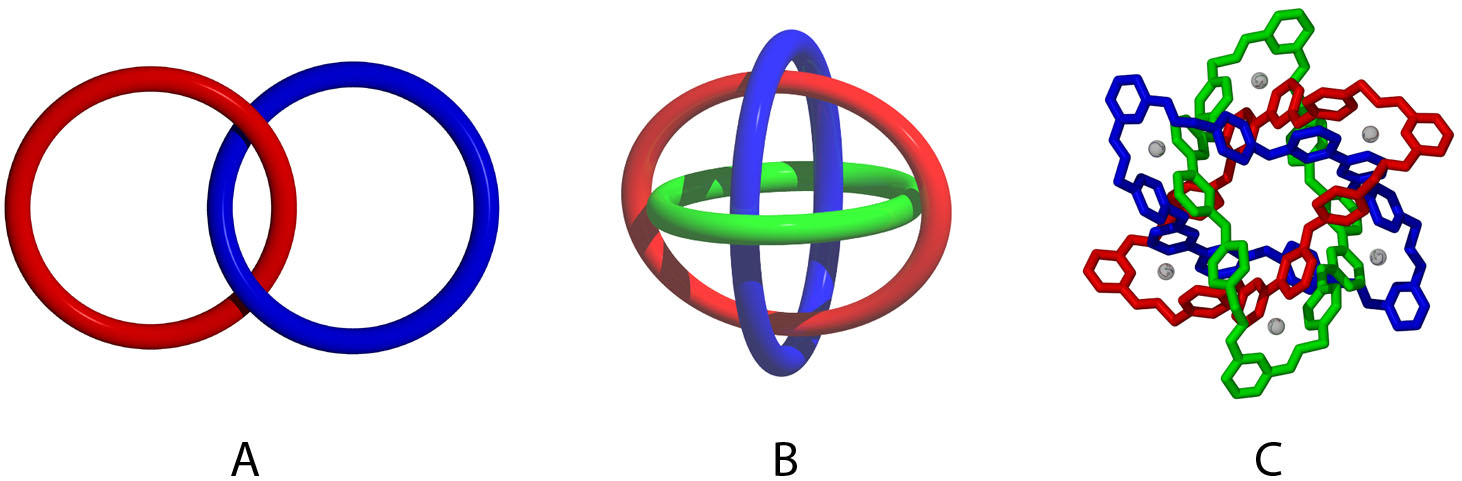
Perhaps one the simplest types of interlocked molecule is a [2]catenane – shown schematically as structure A below. Molecules with this sort of topology are relatively easy to make. You start by making one of the rings (let’s say the red one) and then you thread a linear precursor of the blue ring through the red ring and then tie the ends of the blue thread together to make the blue ring. By using the principles of host–guest chemistry and designing your system so that the red ring and blue thread exhibit mutual molecular recognition, it is possible to make [2]catenanes in very high yield. If you string five rings together like this, you get a compound that looks a bit like something we’ll be seeing a lot more of next year – especially here in the UK.

Interlocked molecules

Another interesting thing about structure A is that it has a non-planar graph. What that means is that no matter how much you stretch or bend either of the rings, you cannot draw the structure in two dimensions without one line crossing another. Most molecules do have a planar graph; sure, you’ll need to bend and elongate bonds to chemically meaningless degrees, but you can draw a net in which none of the bonds cross one another (the nodes are the atoms and the lines that join them are the bonds). Hey, even C60 has a planar graph!

So, if catenanes are fairly straightforward, how about another — slightly more intricate — topology. Structure B above is also known as the Borromean rings, and you can find out a lot more about them and their history here and here. Now, to make these in molecular form is quite a challenge; it’s not just a case of threading a linear molecule through a macrocyle and tying up a few loose ends. And why is it so much harder? Let’s take a closer look at the topology.

Look again at B. Those three rings are interlocked, you can’t separate them just by pulling or twisting on them – and they definitely have a non-planar graph. Now, imagine taking a pair of scissors and snipping the red ring. Pull on one end of what is now a red thread (rather than a ring) and it can be removed from the ensemble. Notice what you have left? A green ring and a blue ring that are not interlocked in any way; they can be simply pulled apart. Start over and do the same thought experiment with your imaginary scissors, but snip either the blue or the green ring. You’ll soon realise that it doesn’t matter which ring you snip, breaking just one of the rings leads to all three unravelling.

What this means, is that no pair of rings in B is catenated (like they are in A), so the strategies applied to making a molecular version of A won’t work for making B. Anyway, this post is getting long and so I won’t go into the gory details of how we did it, but suffice to say that I was part of a team that made a molecular version of the Borromean rings. We weren’t the first, but we made the smallest! If you want to know more (and have access), the original paper is here and a handy review article explaining the synthetic strategy is here.

The X-ray crystal structure of our molecular Borromean rings is shown in C, from which the banner at the top of this page is taken. Just a side note (and probably the topic for a future post), I’m a big fan of making molecules just to make molecules — particularly challenging and funky ones like these — and this project didn’t receive any funding. It was one of those fun side projects in the lab.

And by the way, the molecular Borromean rings aren’t hard to make. We optimised the synthesis on a gram-scale for an undergraduate laboratory course (if you have access, the J. Chem. Educ. paper is here).

Posted in In the lab | Tagged , , , , , , , , , , , , | 3 Comments

The road to hell?

Well, it is my good intention that this site turns into a blog at some point. With witty and insightful posts as well as regular updates (we can all dream a little can’t we…). Stranger things have happened.

I imagine that many of the posts will probably have a chemical-ish slant to them. Maybe. But this isn’t really going to be solely a ‘professional’ blog – there will likely be some personal odds and sods too. Probably not any pictures of kittens, but there are almost certainly enough of those on the web already.

In the meantime, consider this a placeholder. If you’re curious, there is a page dedicated to the publications stemming from the work I did in my previous life as a scientist and also a page highlighting other things I have written since. And if you want to find out a little more about me, there’s a page for that too.

Posted in Housekeeping | Tagged | 1 Comment