Papers published in 2012

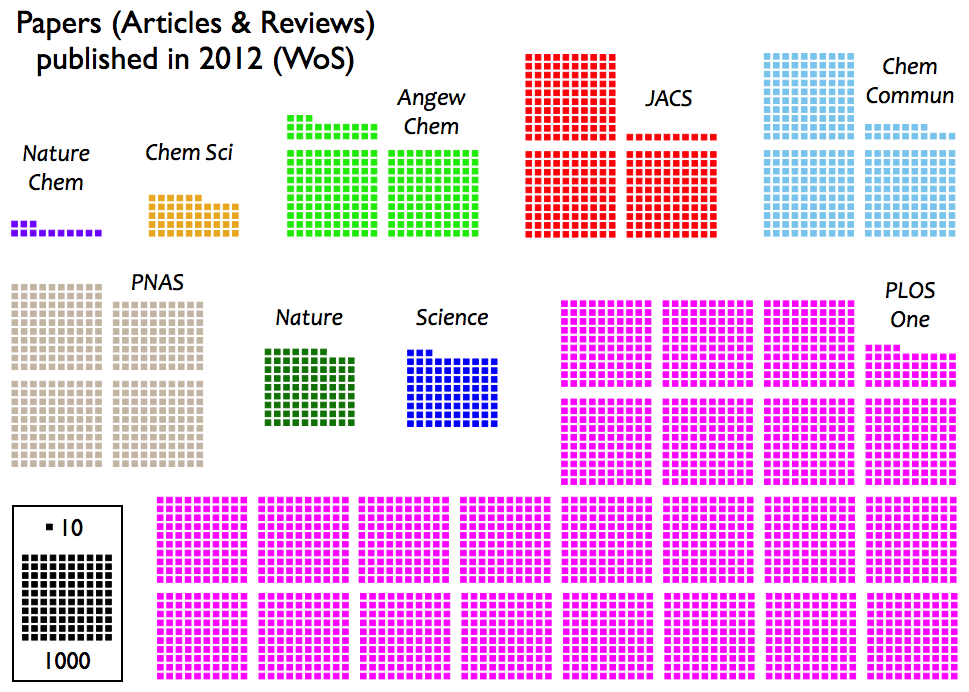
Here’s a copy of a slide from my publishing talk. This compares the numbers of papers published in some general chemistry journals and a few non-chemistry-specific journals; it hammers home just how big PLOS One is! The data comes from Web of Science (WoS) for 2012, and the results are refined for article types ‘Articles’ and ‘Reviews’. PLOS One accounts for just under 2% of all 2012 papers in WoS using these criteria. (Numbers of publications for each journal have been rounded to the nearest 10 for the purposes of the slide).

papers_in_2012

Posted in Metrics, Publishing | Tagged , , , | 2 Comments

Friday fun: Selling yourself

Over the last few days I’ve been updating some of the slides I use in my ‘Scientific publishing and communicating chemistry’ talk. One of the slides looks at five general-chemistry journals and pulls some quotes from their websites that they use to describe/sell themselves. At this point, I should disclose/remind you, that I am the editor of one of these journals (the one with ‘Nature‘ at the start of its name). My slide doesn’t reveal which quotes belong to which journal and I have a bit of fun with the audience as they try to guess. I’ve pulled a few more quotes off the websites for the purposes of this post (in addition to the ones on my slide) and so — without cheating by looking them up — can you work out which quotes belong to which of the following journals?

[Images taken from the websites of the respective publishers and copyright NPG, Wiley, ACS, RSC, respectively]

[Images taken from the websites of the respective publishers and copyright NPG, Wiley, ACS, RSC, respectively]

1. “…the world’s preeminent journal in all of chemistry and interfacing areas of science.”

2. “Journal Name, with its excellent Impact Factor of XXXX, is maintaining its leading position among the general chemistry journals.”

3. “At the forefront of the most exciting developments in the chemical sciences, helping to define the important areas by publishing the most significant cutting-edge research.”

4. “Journal Name is . . . dedicated to publishing high-quality papers that describe the most significant and cutting-edge research in all areas of chemistry.”

5. “It is one of the prime chemistry journals in the world, with an Impact Factor higher than those of comparable journals.”

6. “Publishing your research in Journal Name means your article will have excellent visibility and will be read and cited quickly by your colleagues.”

7. “The most cited journal in chemistry…”

8. “The leading journal for the publication of communications on important developments in the chemical sciences”

9. “This [Impact Factor] places Journal Name first among all primary research journals in chemistry”

10. “Journal Name is renowned as the fastest publisher of articles providing information on new avenues of research, drawn from all the world’s major areas of chemical research.”

11. “It appears weekly in a highly optimized, reader-friendly format; new articles appear online almost every day.”

12. “In a break with tradition, the journal gives authors the freedom and flexibility to publish more extensive accounts of their novel research without page restrictions.”

I’ll update the post in a few days with some answers and observations. In the meantime, have fun! (I might post some of my other slides in due course too…).

UPDATE 20 June: Here are the answers (sources of quotes are linked)…

Nature Chemistry: #4 and #9
JACS: #1 and #7
Angewandte Chemie: #2, #5 and #11
Chem Sci: #3, #6 and #12
Chem Commun: #8 and #10

How did you do?

I was planning on making some witty/disparaging/snide remarks specifically about some of the statements above, but have thought better of it. Nevertheless, some of the claims range from silly to highly subjective matters of opinion — and whether a journal is ‘prime’, ‘leading’, or ‘preeminent’ is probably something that the community should decide, not the journal itself. But that’s marketing for you.

Posted in Fun, Publishing, Quiz time! | Tagged , , , , , , , , , , , | 1 Comment

Blood brothers

This post is another of those chemistry-free personal ones; you’ve been warned.

My Uncle Jim died a month ago. He was 73. We can debate whether 73 years is a decent age or not at which to shuffle off this mortal coil, but for someone who was not expected to make it past his teens when he was born, I think he did pretty well. Jim is the one on the right in the photo below; in the middle is my Dad and on the left is their older brother, my Uncle John.

bb

I was given this photo just over a week ago at Jim’s funeral and its significance has only really dawned on me in the last few days. There were five brothers in all (and one sister, but she lived only for six weeks or so), but Jim, John and my Dad shared another bond — they were all haemophiliacs. If you’re not familiar with haemophilia, the one-sentence summary is that it is a genetic disorder that affects the ability of a sufferer’s blood to clot: this is obviously not a good thing — if you start bleeding it’s quite important that you subsequently stop bleeding at some point in the not-too-distant future (if you want to know more, here’s the Wikipedia article). Any sons born to a mother who is a carrier of the disease have a 50:50 chance of inheriting the disease or not — it boils down to which X chromosome they get. Of the five brothers born to my paternal grandmother, three drew the short straw and two got lucky — the genetic dice did not fall kindly for my Dad’s parents.

Both Jim and my Dad were born while Europe was in the throes of the Second World War (John arrived before it all kicked off) and haemophiliacs born at this time were not expected to make it out of their teenage years. Nevertheless, there I was at my Uncle’s funeral just over a week ago marvelling at the fact he’d made it to 73. Uncle John died a few years back now, but I’m pretty sure he made it to his mid-50s before being struck down by cancer. My Dad? Well, I’ve blogged about this before — he died at 48, but if it hadn’t been for the contaminated blood transfusion which led to HIV and then AIDS, perhaps he’d still be around. Nevertheless, all three of them made it well beyond their teenage years — something to be thankful for in all of this.

Anyway, back to my Uncle Jim. I wanted to write something because something deserves to be said about the way he lived his life. Faced with a chronic (and serious) medical condition he was never going to lead a normal life, but he was one of the most cheerful people I have had the pleasure of knowing. From what I saw, he was happy with his lot and he just got on with it. Although he arrived into the world — and departed from it — in the same small family bungalow; born and died no more than a few yards apart I suspect, those 73 years inbetween were lived well and he brought happiness to many, myself included. Rest in peace Uncle Jim.

Posted in Life stories | Tagged , , , , , , | Leave a comment

The star-spangled postdoc

This post is part of the #BRSMblogparty organized by @JessTheChemist and @AzaPrins to wish @BRSM_blog all the best for his impending postdoc in the US. I spent almost 9 years on the west coast (in the Los Angeles area) and so hopefully some of the points I make below won’t be hopelessly out of date…

Apologies for not using the template, but here are a few things I think @BRSM_blog should know:

1. As Jess has already pointed out, turning right at red lights is awesome. Shame we can’t do the same thing here in the UK — turning left, that is; right turns on red here at home would make things somewhat interesting (and crashy).

2. Another driving tip — there are very few roundabouts in the US and they are called ‘traffic circles’. I think that nobody knows how to use them.

3. Immediately after the opening credits of many TV shows in the US there is an advert break. This is as annoying as it sounds.

4. ‘Amide’ and ‘azide’ are pronounced as if they were spelled without the ‘e’ at the end. It sounds really weird. After one conversation with an American prof I had to ask someone what a ‘zid’ was; I had no idea.

5. Fanny doesn’t mean what I imagine many Brits think it means.

6. America has only four types of cheese: American (naturally), Swiss, Provolone and Monterey Jack. (OK, I’m exaggerating, but it sure did seem that way…). Oh, hang on, there’s that spray cheese too!

7. On a related note, it’s a similar situation with crisps — which, of course, are called chips. I don’t recall there being a great range of flavours beyond barbecue or sour cream and onion. Funyuns are brilliant though.

8. Other food notes: the milk tastes different to how it does over here, and forget about skimmed, semi-skimmed and whole — the US has it’s own nomenclature system.

9. It’s mostly beef, beef and beef. I found the meat selection in supermarkets somewhat limited. And if you’re a fan of lamb, well, you might be disappointed. Having said that, the steak in the US is amazing.

10. Continuing the meat theme, bacon is somewhat limited and sausage is not sausage as you know it. You’ll see.

11. The price displayed on an item is not the price you pay — that takes some getting used to. Figure out what the sales-tax rate is in the state you’re going to (it varies on a state-by-state basis) and then don’t forget to add that to the listed price.

12. You’ll probably need to file taxes. You’ll probably wish you didn’t have to.

13. College football is awesome — go to a game or two (or three). It’s much better than the NFL. Try to catch a baseball game too (MLB, not college, for that one).

14. Tea is typically something that has ice and lemon in it. This is wrong on so many levels.

15. Thanksgiving is a much bigger holiday than Christmas.

16. Phone numbers are listed with a 3-digit area code at the start. What nobody told me (and many of the rest of us who moved over at the same time) is that, in many cases, you need to dial a ‘1’ before the area code… I don’t know if this gets added automatically with smartphones these days.

17. You must eat at In-N-Out Burger at some point during your stay. It’s the law.

18. Las Vegas. Go. Leave your bank card in your hotel room and only take as much cash out with you as you’re prepared to lose. Go to the buffet at Caesar’s.

19. The best description of local TV news that I heard was given by a comedian at an open-mic night — “I can sum up the local news in 10 words: car chase, car chase, car chase, man in a hole!”

20. I was late for lab on more than one occasion because there was a live car chase on TV when I got up for breakfast. I am not necessarily proud of this…

I realise a lot of these are perhaps negative, but there are many positive things about the US when it comes to living and working there. I leave it to you to figure out the rest. Have a great time. Work hard, play hard, and make the most of being in a different place. Immerse yourself in the culture and travel as much as you can. Have fun!

Posted in Carnivals, Fun | Tagged , | 2 Comments

Screw stereochemistry!

I saw my former PhD boss (Fraser Stoddart) over the weekend and he had a challenge for me. And I can’t resist a challenge. He gave me a copy of the midterm he had just given his grad class and suggested I have a crack at question 1. Here it is:

1. Give the possible symmetries (point groups) for the following four objects, considering all of the possible permutations in which the objects may be assembled. In each case, identify the symmetry elements as well (50 pts).

a. A flat cardboard square, through the four corners of which four nails have been driven perpendicularly.
b. Ditto, with four right-handed screws replacing the nails.
c. Ditto, with one left-handed and three right-handed screws replacing the nails.
d. Ditto, with two left-handed and two right-handed screws replacing the nails.

Bonus: Identify any squares which are enantiomers of each other (1 pt each).

Hints: (1) Use scratch paper first! (2) Representing the cardboard squares as stereocenter-containing organic compounds may help your thought processes. (3) You should end up with 25-35 unique solutions to this problem.

Because we lead a kinda rock-and-roll lifestyle, my wife and I sat down the following evening to have a go at the question — she’s much better at this symmetry stuff than I am. It took us a good couple of hours (incidentally, that’s the time allotted for the whole midterm — 5 questions in total — not just question 1…), and we had to look up the flowcharts for assigning point groups, but we ended up getting them all right and just missed one pair of enantiomers. So, if you have an hour or two to kill and fancy getting your head around some stereochem/symmetry problems, give it a go. I’ll post up our answers in a few days. If you look hard enough on Twitter, you’ll find them there too.

Fraser pointed out that the question is not his; he took it from the 1966 edition of Introduction to Stereochemistry by Kurt Mislow.

All the best exam questions come from textbooks that the current crop of students haven’t read… and what’s that on the cover, graphene!?

All the best exam questions come from textbooks that the current crop of students haven’t read… and what’s that on the cover, graphene!?

One clue of my own: don’t forget about axes of improper rotation and centres of inversion… and good luck! Let me know how you do in the comments section.

— — — — — — — — — — —

UPDATE — here are the answers

Posted in Fun, Quiz time! | Tagged , , , , , , , | 1 Comment

A pocket full of what now?

I received the e-mail from @SeeArrOh a little while ago about the impending #ChemMovieCarnival, but I figured I would just be too busy to join in. After seeing the first round up of posts, however, I couldn’t resist, so here’s my contribution.

I’m going to tackle the cinematic masterpiece that is Superman III — there really is some fantastic chemistry in there that I want to share with you (you might want to look up all of the definitions of ‘fantastic’…).

Clark Kent (I’m not gonna spoil it for you guys if I tell you that he’s really Superman am I?) is heading back to Smallville to go to his high-school reunion when the bus he’s travelling on is pulled over because there is a fire in a chemical plant close to the road. The cop who pulls over the bus is perhaps exhibiting some mild symptoms of chemophobia when he tells the driver that, “It’s not just a building, it’s a chemical plant. You know what I mean, it’s like, err, it’s like chemicals.” It’s not long before Superman arrives on the scene and he sets about rescuing workers trapped on (and in) the building. In one room he finds a scientist (he must be a scientist, he’s wearing a lab coat) who refuses to leave — the conversation goes like this:

Scientist: I gotta stay and look after those. That’s concentrated beltric acid. If that stuff heats up over 180 degrees we’ve got a crisis on our hands that’ll make this fire look like a Sunday-school picnic.

Superman: What does it do?

Scientist: As long as it remains stable it’s just ordinary acid, no problem. But if it begins to heat up, it’ll turn volatile. If that happens you’ll get a great cloud of smoke that’ll eat through anything, steel, concrete, anything.
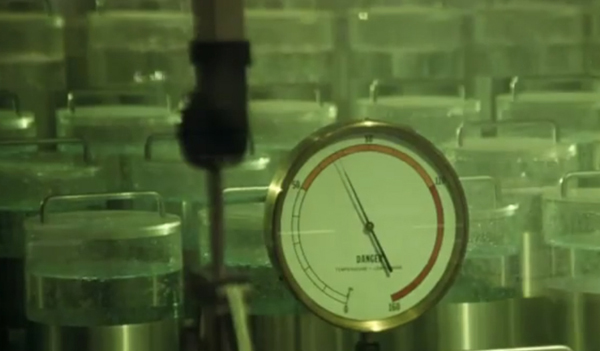
Oh my! It’s beltric acid. And that dial, all it seems to measure is ‘DANGER’. What are the SI units for DANGER?

Oh my! It’s beltric acid. And that dial, all it seems to measure is ‘DANGER’. What are the SI units for DANGER?

Superman, of course, saves the day, and the beltric acid is safe. For now.

The movie continues, and the villain of the piece — businessman Ross Webster (played by Robert Vaughn) — decides to get rid of Superman after the man of steel thwarts his plans to destroy Colombia’s coffee crop. How do you get rid of Superman? Well, you just need some kryptonite. And what if you can’t get any kryptonite? Simple, just figure out what it is made of and then synthesize some in the lab — yay, chemical synthesis FTW!

After Gus Gorman (played by the genius Richard Pryor) gets caught skimming off the half cents not paid to the employees of Webscoe into his own expenses account, Webster puts Gorman’s computer programming skills to use in his evil schemes — including the plan to make kyrptonite. So, how does it all work? If you haven’t already suspended belief yet, now would be good. Gorman hacks into a weather satellite and uses it scan the region of space where the planet Krypton used to be. It amuses me that the computer can’t spell…

'i' before 'e', accept after 'c' when... you know the rest...

‘i’ before ‘e’, except after ‘c’ when… you know the rest.

Webster describes the rest of the plan in a voice-over:

Then the laser probe simply locks on to a floating chunk of kryptonite, the computer analyses the components, and the boys at the lab duplicate the stuff down here.

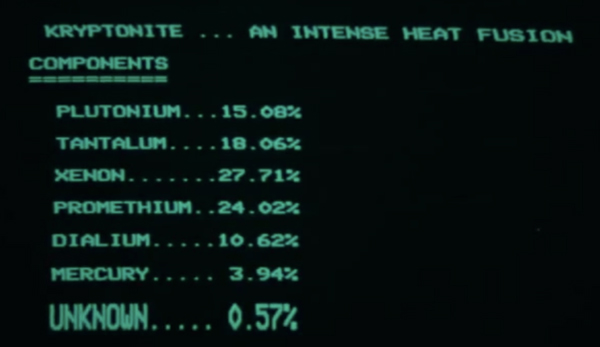
‘Simply’?! OK, first off, I know this is a movie, but allow me to point out the flaw in the logic here. You don’t know what kryptonite is, so how do you lock on to a floating chunk of it? How do you know that you haven’t locked on to lump of adamantium, dilithium or vibranium? Anyway, back to the plot. That’s some awesome analytical chemistry going on right there. A laser fired from a satellite hits a lump of kryptonite and the computer back on Earth figures out exactly what it’s made of — here are the results:

Decrypting kryptonite: dialium anyone? And no krypton? That's disappointing.

Decrypting kryptonite. Dialium anyone? And no krypton? That’s disappointing.

That’s some pretty potent stuff right there. I’m not from Krypton, but you wouldn’t catch me going anywhere near Kryptonite.

Rather than leaving it to the scientists to decide what to do about that small amount of ‘unknown’ — such as just leaving it out — Gorman gets some inspiration from the side of his cigarette packet and decides to swap ‘unknown’ for ‘tar’. The details get sent off to the ‘boys at the lab’ and they set about making synthetic kryptonite — it must have been a fun prep… and just imagine filling in the safety assessment for that one! (They do full safety assessments in the labs housed in the lairs of evil geniuses don’t they?) And look, they even managed to crystallize the product:

PuTaXePmDa(?)HgC — or synthetic kryptonite if you prefer.

PuTaXePmDa(?)HgC — or synthetic kryptonite if you prefer.

The whole synthetic-kryptonite plot-line is discussed in more detail at this website — I’ve tried to avoid directly repeating what is said over there and I recommend that you go and have a read to learn about alternative theories on the composition of kryptonite, including the one put forward in Superman Returns and its similarity to the naturally occurring Earth mineral jadarite. If you really want to delve deeper, apparently there are lots of different forms of kryptonite (polymorphs perhaps?).

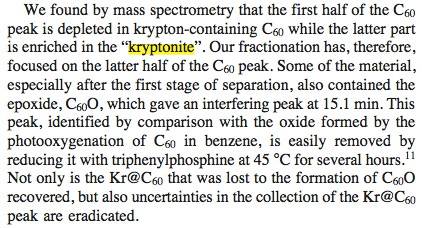
To finish off, however, let’s bring this back down to Earth. Did you know that ‘kryptonite’ has been synthesized in a real chemistry lab and the results were reported in JACS? Yes, really! The paper, Isolation and Spectral Properties of Kr@C60, a Stable van der Waals Molecule, was published in 1999 and the kryptonite in question is the compound made up of a krypton atom trapped inside the buckminsterfullerene cage — an example of an endohedral fullerene. Seems like a reasonable name to me, it has krypton in it after all! And here’s the proof from the paper itself:

JACS — the journal of choice for all of your synthetic kryptonite work.

JACS — the journal of choice for all of your synthetic kryptonite work.

Alas, a search for ‘beltric acid’ in the scientific literature didn’t turn anything up. So, chemists of the world, here’s your challenge. Who will be the first to make a new compound called beltric acid and get it published in a reputable chemistry journal? That would be super, man.

Posted in Carnivals | Tagged , , , , , , , , , , , , , , , | 7 Comments

For the record

Sarah Everts from C&EN was kind enough to ask me for a comment about Angewandte Chemie to include in her article about its 125th anniversary. My quote is in the third paragraph from the end, but as with all these types of things, not everything that I said could be used and Sarah picked out the most appropriate bit for the piece (and checked with me first).

Just for the record, however, here is the full comment that I sent to Sarah in response to her request, noting just what an impact I think Angewandte has had on chemistry publishing:

In many ways, Angewandte has blazed a trail when it comes to the ‘how’ of publishing research in chemistry – but also scientific publishing in general it could be argued. When researching an editorial for Nature Chemistry on the origins of graphical abstracts, it should have come as no surprise when the earliest examples I could find were from Angewandte Chemie. They started as a regular feature in the German edition in 1976 (I think) and then appeared in the International edition the following year. It took many years for other publishers to catch up. Another innovation in chemistry publishing championed by Angewandte were the striking images that graced the front cover of the printed journal (when all there was was the printed journal). In the days when Angewandte were putting nice pictures on the front of each issue, rival publishers still had plain (and somewhat dull) covers that, in some cases, even included the start of the table-of-contents (which was just text); again, many chemistry journals were slow to follow this lead. Finally, if memory serves me correctly, it was Angewandte that first made chemistry publishing colourful. While others were producing issues in black and white (with perhaps some greyscale thrown in for good measure), colour images were regularly gracing the pages of Angewandte Chemie. There is no doubt that many of the publishing innovations pioneered by Angewandte have inspired other journals since. As a graduate student and postdoc it was a journal I aspired to publish in and now as an editor of a competing journal it is one of the first places I look when I’m searching for interesting work to highlight in Nature Chemistry that we didn’t publish ourselves.

[Update — here’s a link to the Nature Chemistry Editorial that I mention above]

Posted in Publishing | Tagged , , , , , , | Leave a comment

The times they aren’t a-changin’

Thanks to @drpeterrodgers for pointing out these two chemistry-related articles from Nature in 1970.

First up, is Chemists are Like Dodos (you need to be a subscriber — sorry), which looks at a report by Prof. Colin Eaborn entitled, ‘Committee of Enquiry into the Relationship between University Courses in Chemistry and the Needs of Industry’ for the Royal Institute of Chemistry. Here’s a quote from the article:

With touching devotion to the belief that chemistry is not so much a discipline as a virtue, the committee proclaims the advantages of the present system for training chemists at British universities, deplores the way in which students appear to be increasingly unwilling to exploit these advantages, bemoans the difficulties which beset graduates seeking jobs and then hopes—its recommendations are hardly better—that by some magic everything will come right. In much the same spirit, no doubt, the last of the now vanished quill pen manufacturers must have wrung their hands in bewilderment over the falling away in trade. Are not our quill pens as good or even better than ever? Is it not mere fickleness and even fecklessness that has driven the customers away? And will not everything be right again if we hang on (with government subsidies to help) waiting for people to change? This, at least, is what the least adventurous among the quill makers would have said—their more farsighted colleagues would have been investing heavily in the manufacture of steel nibs. The danger now, in British chemistry, is that Professor Eaborn’s report will serve only to undermine the flickering resolution of those who may have considered that the time is right for change.

Ouch!

Following on is a second piece, No Formula for Change (again, subscribers only), which opens as thus:

A SORRY tale of a declining proportion of the most able students being attracted to university chemistry courses and of poor prospects for chemists in the job market is told in a report published this week by the Royal Institute of Chemistry.

Oh dear…

It seems that chemistry has similar issues/problems, whether in 1970 or 2013 — not enough jobs and we’re just not willing to change (enough).

Posted in Careers | Tagged , , , , , | Leave a comment

The periodic table of Twitter

So, you’re a chemist and you’ve finally decided to find out what all the fuss is about with this thing called Twitter. You decide to sign up, but, for whatever reason, you don’t fancy using your own name. Maybe an element; that would be cool wouldn’t it? You are a chemist after all. Maybe you work with Grubbs’ catalyst a lot, and you like the idea of being @ruthenium. Or perhaps Stille/Suzuki/Heck couplings are your thing and so @palladium seems appropriate. Not into metals? Well why not @fluorine, @helium or @bromine?

Well, I’m sorry to report that all of those are taken, but there are 114 named elements (we’re ignoring those ununelementium placeholder names) to choose from. Surely some of the more exotic elements must be there for the taking? Well, no. Gone. All of ’em. Thought you’d sneak in and claim one of the two newest additions to the periodic table @flerovium or @livermorium? Sorry, you’ve been beaten to them.

OK, you’re not going to be defeated. You’re smart. How about a bit of a twist? Perhaps you could be @deuterium or @tritium. Sorry, gone and gone. Ah, but what about elements 13, 16 and 55, with the variations in their spelling? Well, @aluminium and @aluminum are both taken. The same goes for @sulfur and @sulphur (the latter of which is unacceptable anyway). Both @caesium and @cesium have been claimed too. And whether it’s ironic (or you just can’t spell), somebody has even beaten you to @flourine.

Somewhat disappointingly, many of the elemental accounts have very little to do with the element in question — or with chemistry. I’m not going to cover them all (they are linked in the periodic table at the bottom of this post if you care that much…), but thought I would highlight some of them. First up is @nitrogen, simply because his bio states that, “I ponder the universe and eat bacon” — I wish I did that for a living. Another intriguing bio belongs to @neon, who is a “Gangnam style professional dancer” — alas, it is a protected account, otherwise I imagine it would be followed by billions of people by now (rather than the 191 it currently has).

The first account with a pretty strong link to its elemental name is @titanium, which is run by the Titanium Information Group. If you are wondering, they are “an association of titanium suppliers, fabricators, users and researchers, working together to promote the use of titanium”. I’m sure all 62 of their current followers are getting their fill of titanium trivia. The first bio that I happened to notice containing the word ‘chemist’ is that of @gallium — he’s only got 16 followers but says he is a nice guy, so why not give him a follow?

I feel that I must mention @technetium, a Brand Marketing Company, mostly because they only have 225 followers at the moment. Perhaps they need to hire a company to improve their brand. In fact, maybe they should use the services of Promethium Marketing (@promethium) who have a much healthier 5938 followers. Although the first line of their Twitter bio states, “We ignite passion”. Well, I don’t know about you, but that conjures up some weird (and frankly disturbing) mental images for me.

The one other element that sticks out is xenon — for no other reason than the fact that the account has been suspended. Naughty @xenon.

The final word goes to @dysprosium. There is a grand total of 0 tweets from this account, it only follows one other account, and has but 2 followers itself. So why am I pointing out this account? Well, the avatar is a picture of Paul Émile (François) Lecoq de Boisbaudran who was the first person to identify the element dysprosium. De Boisbaudran also discovered a number of other elements, including samarium, europium, gadolinium and gallium — it’s all in the Wikipedia article, which is worth a look.

Edit: OK, I initially limited this to @elementnames, but I won’t be able to sleep tonight if I don’t give @DrRubidium an honourable mention. Follow Ray, she’s awesome. Seriously.

Edit (Jan 24, 2018): Table finally updated to include the four most recent additions to the periodic table, nihonium, moscovium, tennessine and oganesson. Also note that some of the comments above about certain Twitter handles no longer hold true: @nitrogen seems more normal now, as does @neon, alas – and @technetium seems to have a new (protected) owner. It seems that @xenon is still suspended though, so there is that.

And here’s the periodic table of Twitter, with all the accounts linked:

HblankblankblankblankblankblankblankblankblankblankblankblankblankblankblankblankHe
LiBeblankblankblankblankblankblankblankblankblankblankBCNOFNe
NaMgblankblankblankblankblankblankblankblankblankblankAlSiPSClAr
KCaScTiVCrMnFeCoNiCuZnGaGeAsSeBrKr
RbSrYZrNbMoTcRuRhPdAgCdInSnSbTeIXe
CsBaLn_blankHfTaWReOsIrPtAuHgTlPbBiPoAtRn
FrRaAc_blankRfDbSgBhHsMtDsRgCnNhFlMcLvTsOg

blankblankblankLaCePrNdPmSmEuGdTbDyHoErTmYbLu
blankblankblankAcThPaUNpPuAmCmBkCfEsFmMdNoLr

Posted in Fun | Tagged , , , , , , | 22 Comments

Where you all come from to read this stuff

I see that Henry Rzepa just put up a post about where the readers of his blog come from. 144 countries, with India at number 3, and so on. I thought I’d put mine up for comparison — these are the numbers from Feb 25th, 2012 until now — only 104 countries for me. And come on Madagascar — what are you all reading?!

blog_stats

Posted in Metrics | Tagged , , , , , , | Leave a comment