
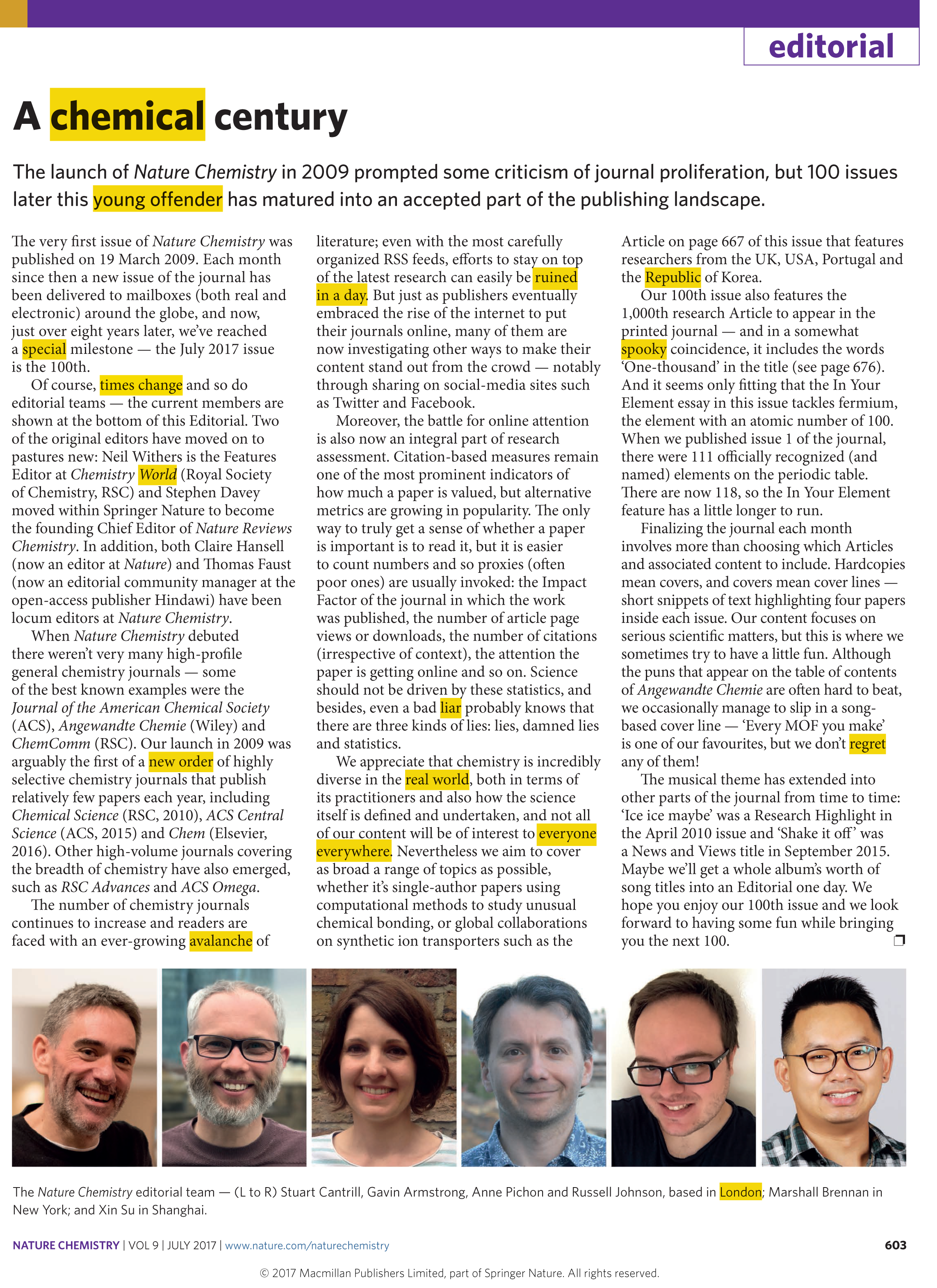
A few months ago I wrote a post for an internal blog at work about getting started with Twitter… I figure enough time has passed that I can now share it with a wider audience. It’s sort of a Twitter-101, so those of you familiar with Twitter will know all of this, but maybe it’s something to point to when suggesting to others that they might like to dip a toe in the water. Many thanks to Anne Pichon (@AnneNotInTokyo) for proofreading the first version of this post and providing helpful feedback.
–––––––––––––––––––
As with most people, I suspect, I signed up to Twitter not really having any idea what it might be useful for. The trigger was one of Nature Chemistry‘s sister journals, Nature Materials, signing up to Twitter; after noticing that they had taken the plunge, in March of 2009 I created accounts for myself (@stuartcantrill) and the journal (@NatureChemistry). The journal account now has more than 200k followers and we use it to tweet about anything related to chemistry that we think our followers might find interesting.
Over this same period, I have also been tweeting a lot from my own account and the experience of handling a personal account and a ‘brand’ account at the same time has been interesting. What follows below is a mixture of ‘Twitter-101’ — some hints and tips for getting started — as well as some other things to think about if you plan on diving in to the Twittersphere.
1. Profile picture
Each Twitter account has a profile picture; for an organization this is usually a logo, but for personal accounts most people use a headshot. This literally puts a face to the account and makes it more human — others will know who they are interacting with and it can be helpful for recognizing people at conferences (assuming you want to be recognized at conferences, of course!).
Twitter is not LinkedIn, however, so you don’t need a rigid, formal headshot if you don’t want to use one. Choose something you are happy with that represents you — some people even use a cartoon version of themselves. Note to the more experienced users: do remember to update your profile picture once in a while, don’t keep using the same one from 10 years ago!
2. Username/Twitter handle
These are actually two different things. Your Twitter handle is the thing with the ‘@’ symbol in front of it and it can’t have any spaces in it. This is also how you are mentioned in the text of tweets (whether your own or others). Your username can be longer and can have spaces and punctuation in it; this appears on your profile page and also at the top of any tweet you write. When other people receive notifications of your activity, it will refer to you by your username rather than your Twitter handle.
I realise this might all sound a bit complicated, but you soon get used to it. For example, my Twitter handle is @stuartcantrill and my username is ‘Stuart Cantrill’; very similar, but not quite the same. The fact you have both can be quite handy for organizations (or people) with long names. For example, the journal Nature Communications uses its full name as its Twitter username, but its Twitter handle is @NatureComms. I recommend using something recognizable — but as short as possible — as your Twitter handle and then using your full name as your username.
3. Completing your profile
As well as your profile picture, you can also have a header image; this will appear at the top of your profile page. This is probably the least important part of your profile, but choose an image that you like or one that represents you or your interests. Do make use of the biography section. You get a limited number of characters, but here you can explain who you are and what you do.
You can tag related Twitter accounts into your bio; mine mentions my wife, my daughter and the journal I work on. You also get to add a location (it can be useful if people know what time zone you are based in if they are trying to contact you) as well as a link: this could be to your research home page or even to your LinkedIn profile if you prefer.
4. Follow other accounts
The way Twitter works is that you see a stream of tweets from accounts who you choose to follow, as such, you get to curate what you see in your Twitter timeline — apart from the sponsored crap that Twitter dumps into it, alas. There are ways around this; for example, you can set up a list of everyone you follow and just use the content produced by that list as your timeline (in fact, you don’t even need to follow the accounts on your list). Also, some Twitter clients filter out a lot of unsolicited timeline rubbish – I hear people rave about Tweetbot a lot, although I rarely use it myself.
You can follow and unfollow people whenever you like (so if you get bored of all my tweets about gin, you can simply unfollow me and my tweets won’t show up in your timeline any more). It’s also not a mutual two-way situation like being a friend with someone on Facebook. I can follow your account and you don’t have to follow mine and vice versa. You can also interact with accounts that you don’t follow. However, somebody will know if you follow them; it’s possible to see who follows an account and who that account follows.
Twitter will often give you suggestions of who to follow; start by identifying accounts you’re interested in hearing from and then you can expand your network by looking at accounts those accounts follow and so on. People you follow may start to follow back and eventually you’ll begin to build a network.
For example, my personal account mirrors my interests, so I follow a lot of chemists, but I also follow news outlets and journalists, I also follow accounts related to gin and wine, as well as accounts that tweet about publishing jobs and also accounts related to Formula 1. My Twitter feed is essentially a stream of content that I have tuned to suit my personal and professional interests.
5. Actually tweeting
You can just sit back and watch what other people say on Twitter; you never have to say anything. Part of why Twitter is useful, however, is because it makes it easy to engage with others. So, what are you going to tweet about? The first decision you need to make is whether your Twitter account is going to reflect your professional life, your personal life, or both. There is no right answer here and you should do what is right for you.
My own account is very much a mixture — in terms of what my interests are, I find it very difficult to separate my professional interests from my personal ones, so I tweet about everything: interesting chemistry, developments in publishing, our family’s summer holidays, my daughter’s maths homework, the most recent bottle of gin I really shouldn’t have bought and so on. I have been told by some people that they appreciate seeing that I’m a (relatively) normal human being, but I have also heard (generally through the grapevine) that some people think I share too much.
And this is why it is up to you what you do. Do what works for you; you shouldn’t feel any pressure to tweet about what fun stuff you did at the weekend if you don’t want to share that. Conversely, if you want to tell everyone that you went bungee jumping over a canyon filled with deadly snakes, go for it.
6. A picture is worth a thousand words (a moving picture is worth more)
Tweets are limited to 280 characters, but a tweet can also contain up to four images or, alternatively, a gif. People tend to notice tweets with images and gifs more than tweets that just contain text. If you want to plug your latest research paper, include a graphic from it. Tweets can also include links to websites and so, where appropriate, include a link to the thing you are talking about, whether it’s your latest paper, a story in Nature or an opinion piece in the Guardian newspaper that has made your blood boil.
7. Engage (if you want)
Again, you should use Twitter in the way that is most effective for you. Sit back and watch what other people say if that’s all you want to do. Or you can do that while also tweeting about things yourself.
What you can also do, however, is interact with other accounts’ tweets. You can ‘like’ tweets (you do this by clicking on the little heart), you can re-tweet someone else’s tweet so that it gets amplified to your followers (you do this by clicking on the arrows that go around in a cycle), you can also re-tweet and add a comment (this is called quote re-tweeting) and you can reply to tweets by others and engage in a conversation.
The more you engage (in a civil and constructive fashion) the more likely you are to get noticed and your network to grow. As with following an account, an account will be notified if you like, re-tweet or reply to one of their tweets.
8. Nice threads
Tweets are limited to 280 characters, so it teaches you to be economical with words. However, sometimes you want to say more than you can fit into a single tweet, and this is where threads can come in handy. If you have a series of connected thoughts or comments, you can link your tweets together in a thread — you can even do this in draft mode and have all the threaded tweets ready to publish at once.
Do not abuse threads though! If you want to write a 500-word blog post, the best thing to do is write a 500-word blog post rather than string together 100-or-so tweets. If someone is going to get bored by tweet number 12, they simply won’t read the rest…
9. Hashtags
A hashtag is a word or phrase (without spaces) that follows the ‘#’ symbol and if you include one in a tweet it will make it easier for others to find tweets related to that topic. Conference hashtags can be useful if you want to see what’s happening at a specific conference — all the tweets from #ACSSanDiego for example.
There are also topic-related hashtags, such as #RealTimeChem (where people describe the chemistry they are up to) or #chemjobs where someone is posting about an open position related to chemistry. The Royal Society of Chemistry even host a virtual conference on Twitter every year where thousands of people upload posters on a given day. The main hashtag is #RSCPoster, but then there are different hashtags for all of the individual disciplines.
Hashtags are also a good way to highlight belonging to a community or flagging content to a community that might be interested in a tweet — one popular example is #WomenInSTEM.
One word of caution, however, if a hashtag is too general or too broad, there is probably little point in using it. Using #chemistry or #science or #news as hashtags is not going to be all that helpful. And try to limit yourself to no more than two or three hashtags per tweet; if a tweet is mostly a string of hashtags, it makes the tweet really hard to read!
10. Tweeting *is* publishing
Read your organization’s social media policy and adhere to it (or question bits of it if there is anything you disagree with). Clearly it is not a good idea to say anything that would reflect badly upon your institution. When thinking about your own research, think about what you can and cannot put out into the public domain. Are you scooping yourself? Or would it be useful to solicit feedback on a particular research project from your contacts in the Twittersphere?
Similarly, if you run a research group, make it clear to your students what they can and cannot tweet about the work they are doing. If you are unsure about whether to tweet something, then you already have your answer. If you have any doubts, it’s probably best not to tweet the thing in question.
And remember, sure, you can delete a tweet, but it only takes a second for someone else to take a screenshot of your tweet and post it to their own Twitter account, so think carefully before hitting the tweet button.
11. It’s not all rainbows and unicorns
For the most part, my experience with Twitter has been largely positive, but as with any social network, there are individuals on Twitter who can be very unpleasant. Some people have experienced horrific online abuse and have been driven from the platform and the powers-that-be at Twitter HQ are not exactly great at policing Twitter.
If you come across unpleasantness (or worse) then you have some options. You can simply ignore the trolls (I appreciate this is not a coping mechanism for everybody and it depends on how many trolls there are and how active they are). You can mute accounts that you never want to hear from again. You won’t see what they say and they won’t know you have muted them — they will essentially be screaming into the void as far as you are concerned.
The next level is that you can block them. This means that they cannot see your tweets (they can, of course, log in to Twitter with a different account and get around that limitation) and they also cannot mention you or in any way interact with you on Twitter. Unlike muting someone, however, an account will know if you have blocked them. Finally, for really bad abuse that may violate the terms of service of Twitter, there is a report feature, where you can report abusive accounts to Twitter and they may take action (they may not).
As I said, my experiences have largely been positive, but I have blocked a handful of people. I also realise I am making this statement as a middle-aged white man and with that comes a hell of a lot of privilege that means I am unlikely to be anywhere near as much of a target as other demographics. In my experience, ‘Science Twitter’ is, for the most part, a friendly and supportive place, but beware of what you may be exposed to.
12. To sum up…
This post has, obviously, focused on Twitter, but some of the principles at least apply to other social networks. Over the last 10 years Twitter has led to real friendships, it has led to collaboration (a conversation on Twitter that I was involved in ended up leading to some research and, ultimately, the publication of a paper in PLOS One) and I’ve lost count of the number of conference and speaking invitations I have received by being active on the site.
Used in a constructive and positive fashion, Twitter can be a powerful networking tool and can open doors. It’s more than a broadcasting website where celebrities tell us what they had for breakfast; it’s a place where you have access to a highly curated set of professional individuals who you can ask for help and advice. I’ve even heard some users describe it as their support network, where individuals find comfort (and solutions) through shared experiences. As the kids say, however, #YMMV.
Feel free to add your own Twitter tips in the comments below.






 Chemical connections